

Calculating a maintenance fluid rate is one thing. But a dog with pancreatitis and a heart murmur or a dehydrated cat with renal disease can raise questions a fluid calculator can’t answer. That’s where Attending can help. This veterinary-specific AI clinical decision support tool helps with the calculations and the clinical questions that come with them.
Want to see what Attending can do? Try it free for 14 days. No credit card required.
Calculating Maintenance Fluid Rates for Dogs and Cats
Many of us learned to calculate maintenance fluid rates using 60 mL/kg/day for dogs and 40-45 mL/kg/day for cats, but metabolic body weight formulas are another option. The 2024 AAHA Fluid Therapy Guidelines include both approaches, with metabolic formulas of 132 × BW (kg)^0.75 for dogs and 80 × BW (kg)^0.75 for cats (mL/day).
But maintenance is only one part of the plan. You also need to account for dehydration deficits, ongoing losses, and how your patient’s needs may change as treatment progresses.
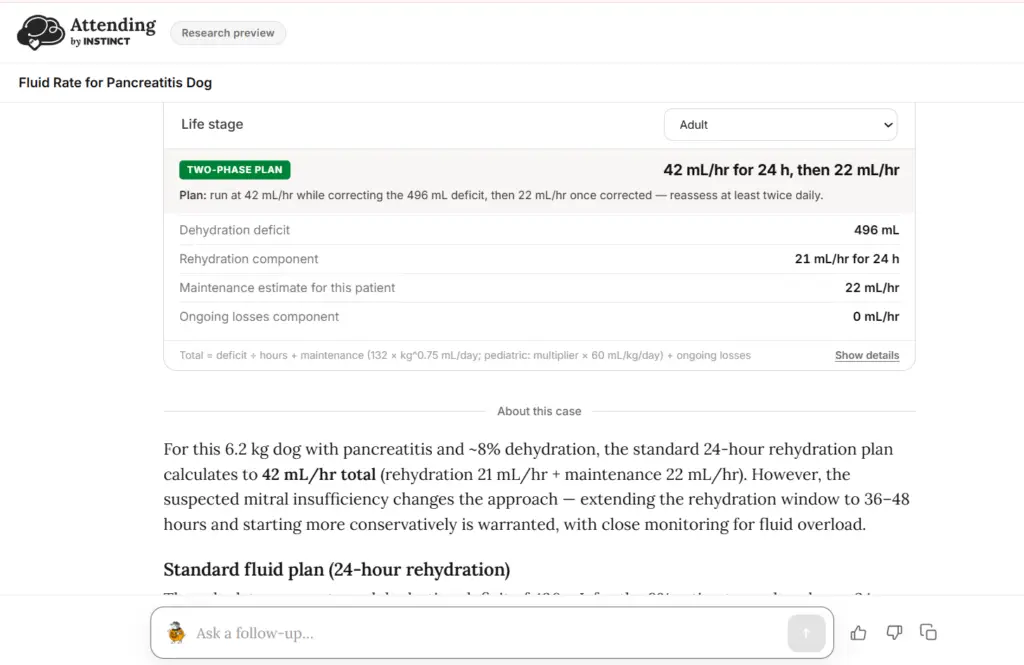
With Attending, you can describe your patient and ask for a fluid rate. It’ll use the information you provide to work through the calculations and show you an initial rate to review and adjust based on your clinical assessment.
And if you’re wondering whether you can trust Attending with the math, its calculators are deterministic. That means they use fixed, established formulas rather than relying on AI to work out the numbers, so the same inputs always produce the same results. You can see how it arrived at those numbers and adjust the inputs as needed.
What About Patients Who Aren’t So Straightforward?
A calculated fluid rate doesn’t always account for everything else going on with your patient, particularly when there are concurrent conditions or other clinical concerns to consider.
Unlike a standalone veterinary fluid calculator, Attending lets you ask questions just like you’d ask a colleague. Give it the whole clinical picture, including your patient’s history, lab results, and concurrent conditions, and ask how those details might affect your fluid plan.
For a dog with pancreatitis, dehydration, and a heart murmur, that might mean asking how suspected mitral valve disease could influence your fluid plan. Attending highlights the potential risk of fluid overload and discusses options such as extending the deficit replacement period, along with what to monitor and what further cardiac assessment might help guide your decisions.
Want to see how a GP veterinarian uses Attending in practice? Read Attending by Instinct: A GP Veterinarian Puts It to the Test
What If Your Patient Needs More Than One Calculation?
Attending can also recognize when another calculation might be helpful based on the clinical information you provide. For example, when you ask Attending to help you work through a fluid plan for a dehydrated cat with chronic kidney disease (CKD) and hypokalemia, it’ll calculate the fluid rate and bring up a Potassium Supplementation Calculator to help with supplementation. It’ll also discuss how the cat’s CKD might affect your approach to fluid therapy and what other factors you may want to consider.
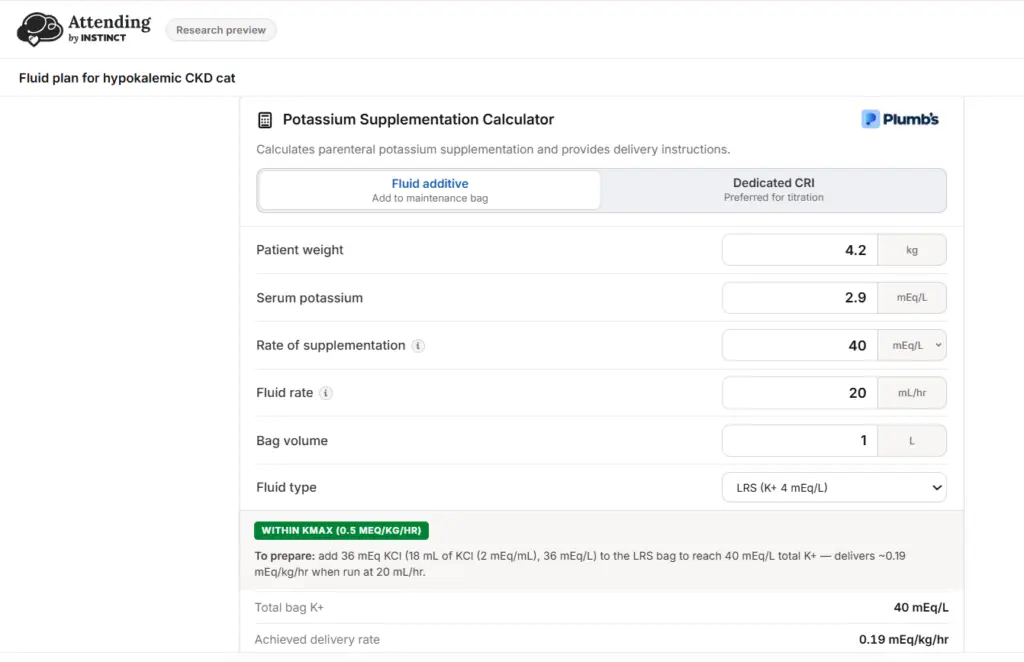
Attending can help with other clinical calculations, including constant rate infusions (CRIs), lean body weight, body surface area, and more, using veterinary-specific calculators from Standards of Care (formerly Plumb’s Pro) and Plumb’s.
When does a veterinary specialist turn to Attending? Find out in: More & More About Less & Less: How a Veterinary Specialist Uses Attending
How Can Attending Help as a Case Develops?
From your initial assessment, you can ask Attending about differentials, diagnostics, and treatment options. As new lab results come in or your patient responds to treatment, you can return to the same conversation to review your options, revisit calculations, or explore new clinical questions.
And when your patient is ready to go home, Attending can help with discharge planning, home care recommendations, client communication, and follow-up questions, with veterinary-specific references you can review along the way.
Where Does Attending Get Its Information?
Attending draws on trusted veterinary resources, including Standards, Plumb’s, and Clinician’s Brief. These resources are developed, reviewed, and regularly updated by veterinary specialists, pharmacists, and other veterinary experts. Attending uses these sources to support its answers, with inline citations you can click to review the original information without having to start a separate search.
Having access to those sources also means you can evaluate the guidance for yourself. Attending can help you consider the different factors that might influence your approach, explore treatment options, and review the research behind them. But it isn’t there to make clinical decisions for you. You’re still the one who puts that information together, considers what you know about your patient, and decides on the best course of action.
Want to know more about the veterinary sources behind Attending’s answers and how they’re reviewed? Read How Attending Builds Trust Into Veterinary AI
Beyond Fluid Calculations: Support for the Whole Case
A fluid rate is only one part of caring for a patient. There are clinical questions to work through, treatment options to weigh, and decisions to revisit as the case develops. With Attending, you can spend less time searching for answers and more time putting the pieces together for the patient in front of you.
Try Attending free for 14 days and see how it can support you through your next case.