

As one of the veterinarians on the Instinct team, a big perk of my job is getting a sneak peek at what we’re building. And every once in a while, I get early access to something new. Attending by Instinct was one of those products and I was pretty eager to try it. It’s an AI-powered clinical decision support tool that helps veterinarians get source-backed answers faster, drawing on trusted veterinary resources such as Standards of Care (formerly Plumb’s Pro), Plumb’s, Clinician’s Brief, and selected peer-reviewed literature.
At first, I mostly just played around with it: asked questions I already knew the answers to, tried different cases, and made a few attempts to stump it. I wanted to see whether the answers held up and whether I could trace them back to sources I trusted.
When It Stopped Feeling Like a Test
Then I asked Attending about my own dog. He’s a 4-year-old standard poodle named Mello and it’s a name that suits him better in theory than in practice. He lives in a glass case of emotion, with anxiety, fear-based reactivity, and a tendency to have paradoxical reactions to behavior medications. I wanted to know what options might still be worth trying and whether his history should change my approach.
Within a few seconds, I was given multiple options that took his medication history into account. I was familiar with using gabapentin for anxiety in cats, but hadn’t really considered it for Mello. Attending showed me recent evidence supporting its use for situational anxiety in dogs and helped me think through how it compared with other options like clonidine.
It also pulled up the Plumb’s Drug Interaction Checker, which gave me a quick way to look for potential interactions as I weighed the different medications.
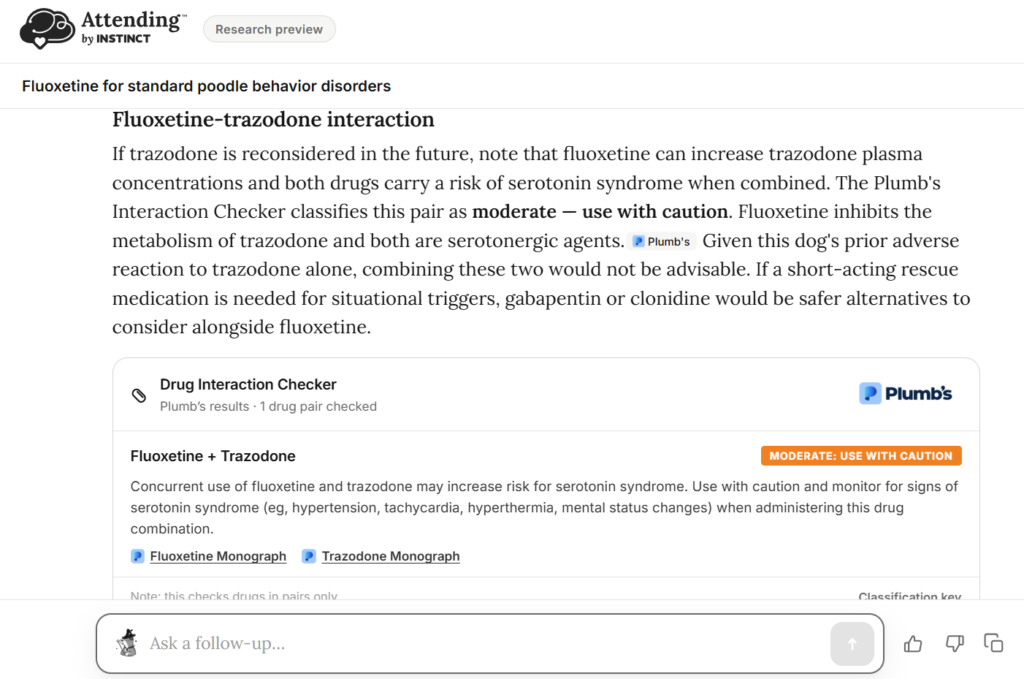
I could have found all of that myself eventually, but it would have meant spending hours going through multiple clinical resources, searching for newer studies, and digging through veterinary discussion forums to piece it all together. Not impossible, but a lot more time and mental effort. That was probably the point when I started thinking less about how well Attending performed and more about all the times I could see myself reaching for it.
Not Just For When I’m Stumped
I started using it more after that and not just for difficult or unfamiliar cases. Sometimes I wanted to know whether newer evidence had changed how I thought about something familiar, like canine aural hematomas or current spay/neuter age recommendations. Other times, I just needed a quick refresher on something I don’t do every day, like a cystotomy in a male dog. I asked Attending to walk me through the approach, suture choice, and postoperative care.
I also liked that I could give Attending the context around the case. In an atopy case, I told Attending that the owner was concerned about long-term steroid use but also had significant cost constraints. Instead of just getting a generic treatment or diagnostic plan, I got a plan that made sense for that particular patient and client.
Patients come in with all sorts of complicated medical histories and personal constraints. I can use Attending to work through what has already been tried, what worked, and what didn’t; and factor in client circumstances when building the treatment plan.
Read: More & More About Less & Less: How a Veterinary Specialist Uses Attending
Read: Trauma or Something More? A Veterinary Case Walkthrough With Standards
Show Me the Sources
The thing that actually made me comfortable with Attending was being able to see where the answers came from. The sources are right there in the response and when I click through, Standards of Care, Plumb’s, and Clinician’s Brief content opens alongside Attending with the relevant section highlighted.
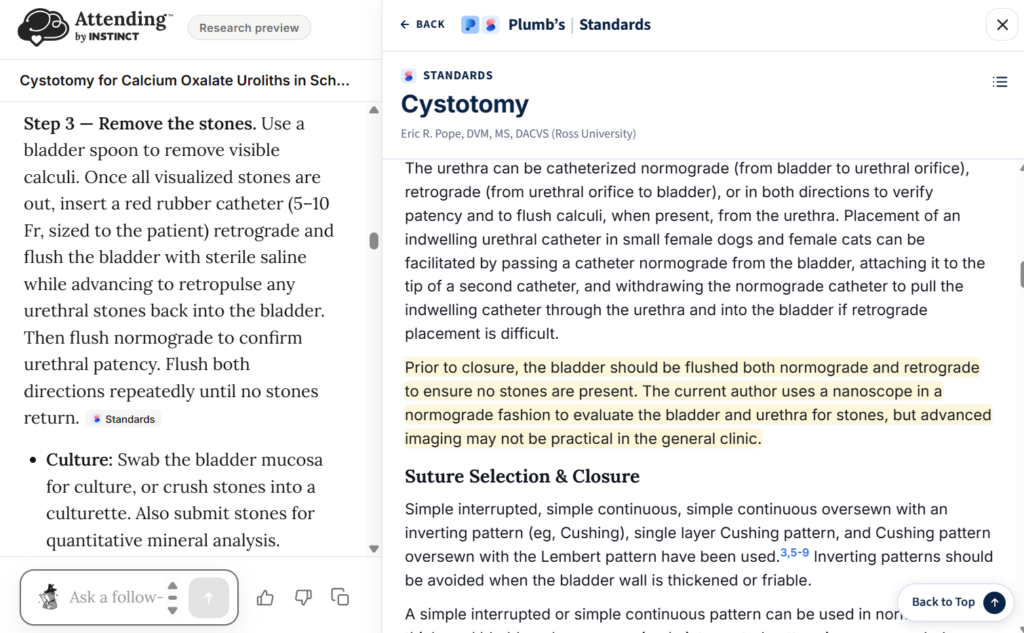
If the source is primary literature, it links out to the original paper. And if I want to go deeper into a Standards, Plumb’s, or Clinician’s Brief source, I can see the references behind that content too, so I can trace the answer back beyond the summary or monograph itself.
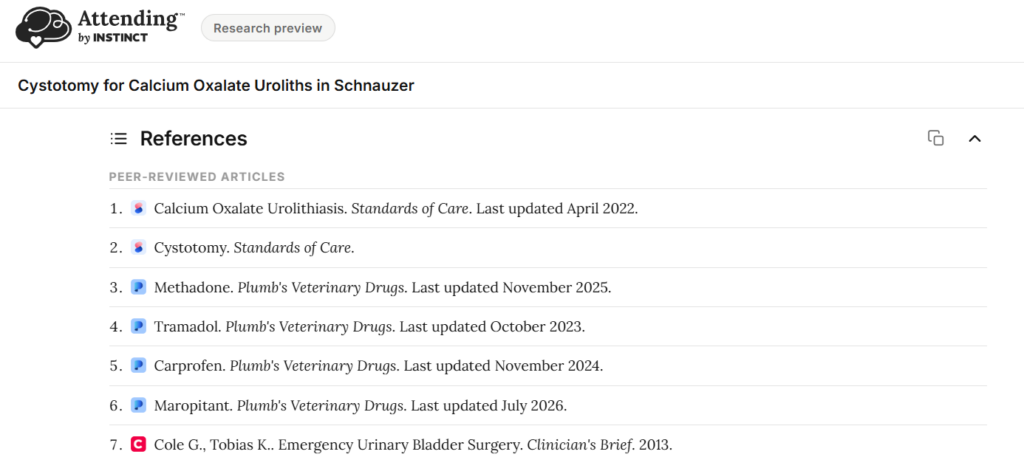
It also helps that these resources are kept up to date. Standards of Care, Plumb’s, and Clinician’s Brief are maintained and updated by a team of veterinary and pharmacy experts as veterinary medicine evolves.
Curious why we built Attending? Caleb Frankel, VMD, CEO of Instinct, shares the thinking behind it and what we wanted veterinary AI to do differently. Read his perspective.
Sometimes I Just Want the Bottom Line
Sometimes I want to take a deep dive into the details. But when I’m already two patients behind and just need to know whether I’m missing something important, I don’t need a literature review; I just need the bottom line. I like being able to get that quick answer first, then dig into the sources if I need to.
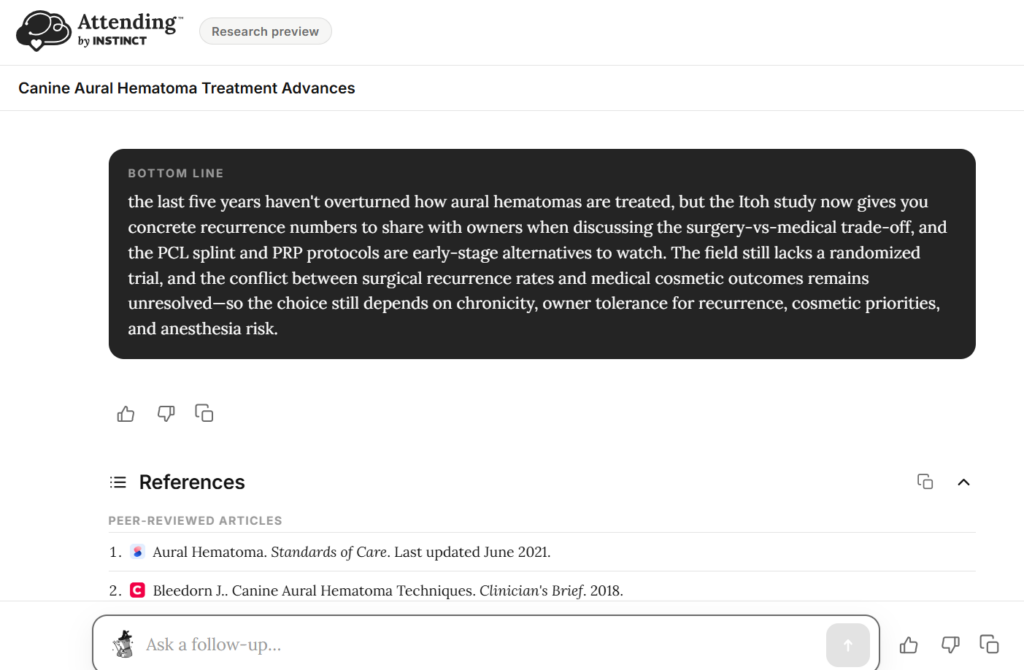
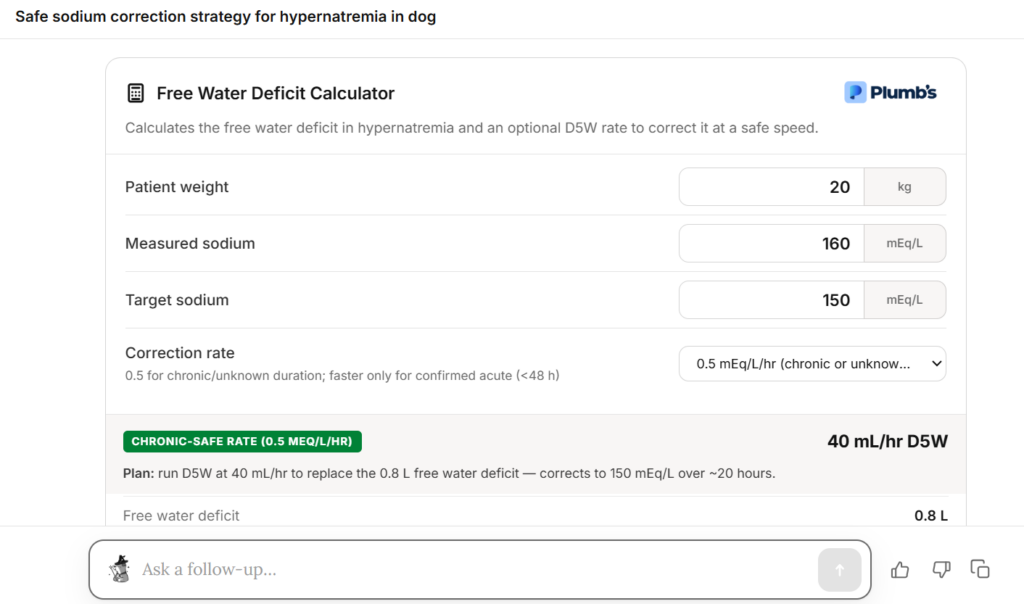
And I like that everything is in one place. If the question involves a calculation, I can handle that there, too. The math is handled by built-in formulas rather than generated by the AI, so the same inputs produce the same result every time. When I asked it to work through a hypernatremia case, Attending showed the calculation and the assumptions behind it so I could follow the math myself.
Why I Keep Reaching for It
Within a week of testing Attending, it had already become something I was reaching for regularly. What I’ve appreciated most is knowing I can quickly get to the information I need, without having to decide which resource to open first or spend time piecing together an answer. It also makes it easier to check myself and catch things I might have missed.
That’s how I want to use veterinary AI. I’m not looking for it to make clinical decisions for me. I just want it to help me find the answer faster and know I can trust the information behind it. Attending frees me up to spend more of my time on the part of my job I enjoy most: putting all the pieces together and making the best decision for the patient in front of me.