

Someone once told me, “As specialists, we know more and more about less and less,” and I’ve felt the truth of it ever since. As a specialist in emergency and critical care, I can manage some of the sickest patients without needing consults or a literature search—but a dermatologic condition or a vaccine question puts me back in fourth-year vet-student territory. Yet, my patients rarely present as single-system problems: a dog with a traumatic brain injury also has eyes, and a septic patient may also carry a chronic dermatologic history. My expertise has given me deep knowledge within my specialty, but the narrower that expertise becomes, the more often a case sits partly outside it.
That gap is where I use Attending by Instinct, an AI-powered clinical decision support tool that pulls answers from resources such as Standards of Care (formerly Plumb’s Pro), Plumb’s, Clinician’s Brief, and peer-reviewed literature. I now rely on it regularly during case management to broaden my knowledge, double-check myself amid clinical chaos, and ensure I’m always practicing the most current, evidence-based medicine.
Read: Introducing Attending: A Message to Our Veterinary Community
Read: How to Evaluate a Veterinary AI Scribe During a Trial
The Dog With a Head Injury & Hyphema
One of the first cases that solidified the Attending’s value for me involved a small dog that presented after being attacked by a bigger dog, with severe traumatic brain injury and concurrent hyphema. The neurologic management was familiar ground; the eye was not. I gave Attending the clinical situation, and it responded with succinct guidance that reflected the systemic case, not just generic hyphema advice. Most importantly, I was able to get this information in under a minute, a fraction of the time it would have taken to dig through journal articles, pull out a dusty textbook, or phone a friend.
Double Check During Chaos
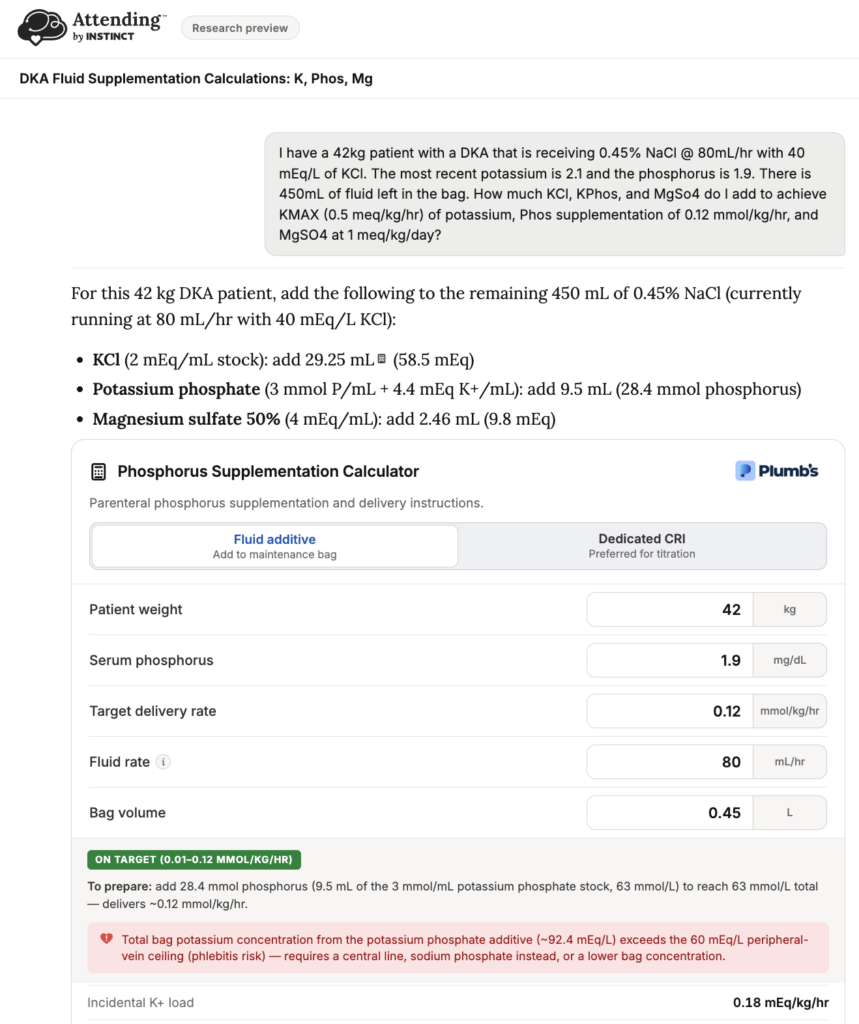
Another way I rely on Attending is during chaotic shifts, when the limiting factor is mental focus rather than knowledge. I run complicated cases through Attending, then use the result as a checklist to make sure I haven’t forgotten anything important. The built-in calculator function is invaluable for complicated calculations, such as frequently changing fluid additives, constant-rate infusions, dilutions, and toxic doses. While I could do the math on my own, having a tool that can double-check my numbers reduces the stress of working through complicated math amid distractions. Calculations are performed using built-in formulas rather than AI-generated math, so the results are reproducible and the calculations are visible. Because those formulas can factor in patient-specific context rather than fixed defaults, they’re more adaptable than a typical hard-coded calculator.
Read: Plan Your 2027 CE: Top 16 Veterinary Conferences
Read: How Multi-Doctor Veterinary Practices Can Support More Consistent Care
Staying on Top of Changing Practices With High Quality References
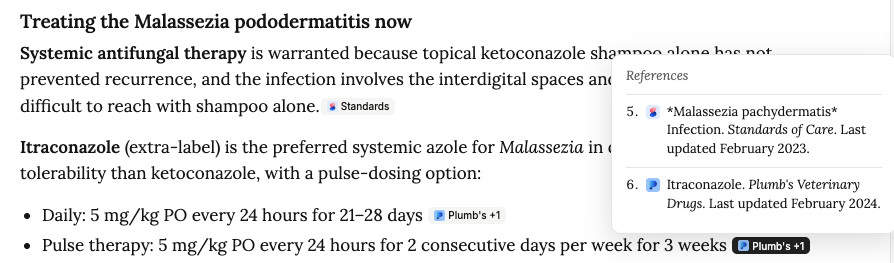
Medicine is always changing, and the number of veterinary publications is increasing exponentially. In 2025, over 8,000 papers were published on canine and feline medicine alone. It would be impossible to keep up with all of the literature. Luckily, Attending has access to PubMed, Standards of Care, Plumb’s, and Clinician’s Brief, enabling rapid access to literature germane to my patient, rather than requiring hours of reading, distilling, and synthesizing to find the answer. Recently published evidence is highlighted to provide key information at a glance, in addition to surfacing Clinical Trials from the AVMA Registry.
I was initially hesitant to rely on Attending for these sources, given how notorious AI tools have become for confabulating references. That risk is real with any AI tool, but two things reduce it here. First, Attending draws from a defined corpus (Standards, Plumb’s, Clinician’s Brief, and PubMed), with the majority of the content already evaluated and vetted by Instinct’s team of veterinarians, specialists, and pharmacists. Second, and more importantly, every claim links back to its source, so I can verify anything before I act on it.
Read: Lessons Learned From Onboarding Hundreds of Emergency & Specialty Veterinary Hospitals
Read: Why Veterinary Hospitals Are Leaving Paper Treatment Sheets Behind
Integrating Attending in My Clinical Toolkit
Attending does not make clinical decisions for me—those decisions depend on information no tool has: how a patient looked an hour ago, what a serial assessment reveals, and what is accessible for the pet owners. Its contribution is narrower: a fast, traceable answer at the edges of my specialty, a check against fatigue, and a way to confirm whether treatment recommendations have changed. Specialization means knowing more and more about less and less. Attending makes the less-and-less a little more manageable.