

As veterinarians, we double-check ourselves all the time. We look up a dose before giving it, check a treatment plan against the latest guidance, or go back to the literature when something doesn’t quite fit. Being careful is good medicine, but all of that takes time. That’s where AI has potential: helping veterinarians get to the information they need faster. But a fast answer is only useful if you can trust the information behind it. That’s where Attending comes in.
Attending Is Grounded in Peer-Reviewed Veterinary Sources
Attending is Instinct Science’s AI-powered clinical decision support tool that helps veterinarians get to source-backed answers faster. When you ask it a question, it starts by looking across evidence-backed sources such as Standards of Care (formerly Plumb’s Pro), Plumb’s, and Clinician’s Brief for the most relevant veterinary information. Attending can also alert users to relevant abstracts from peer-reviewed research, and it searches abstracts from a curated set of veterinary journals rather than the open web.
You can see the sources right alongside the answer, so it’s easy to jump to the relevant reference and review it yourself. If you want to go deeper, you can also see the source material behind that content.
Read: Introducing Attending: A Message to Our Veterinary Community
Read: Plan Your 2027 CE: Top 16 Veterinary Conferences
Standards of Care: Specialist-Written, Continually Updated
Standards includes clinical monographs, algorithms, differential diagnosis tools, procedure guides, and built-in access to Plumb’s for drug information and interaction checking. Every piece of clinical content is authored by specialists, peer-reviewed by other specialists, then reviewed by generalists for point-of-care practicality.
What goes into a clinical monograph?
Standards covers 600+ clinical topics, from diagnosis through treatment, monitoring, and follow-up.
Each monograph starts with a board-certified specialist synthesizing 150 to 250 references, including primary research, consensus guidelines, and book chapters, into clinically actionable guidance. From there, it goes through multiple rounds of veterinary review before publication, including an external specialist in the appropriate area of practice, internal specialists, and a general practitioner who pressure-tests it for real-world use.
That generalist review is especially important. It keeps every monograph grounded in real practice, including alternative options for clinicians to consider when the ideal approach isn’t possible.
Across the platform, Standards draws on 20,000+ references kept current by 200+ veterinary and pharmacy experts. Every monograph shows its own references, so you can always see where the guidance came from.
And publication isn’t the end of the process. Clinical monographs are updated as new research and clinical findings emerge, and new topics are added based on what veterinarians search for and where the team sees gaps.
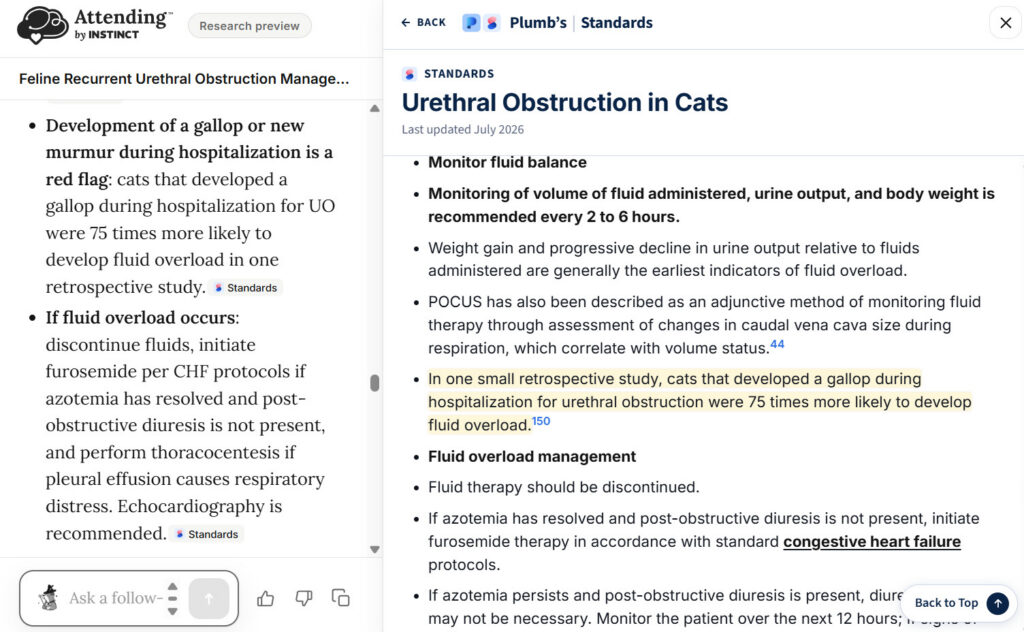
So when you ask Attending about a feline patient with urethral obstruction and concurrent heart disease, you’ll see recently updated Standards guidance on fluid rates, monitoring for fluid overload, and other considerations for cats with cardiac disease.
Plumb’s: Drug Information That’s Kept Current
For medication questions, Attending pulls its information from Plumb’s, the veterinary drug reference trusted by tens of thousands of veterinarians and pharmacists.
Plumb’s includes hundreds of drug monographs developed and regularly updated by veterinary and pharmacy experts. The team reviews peer-reviewed research, consensus statements, FDA approval materials, and other trusted sources to keep the information current. Updates can include new formulations, revised dosing guidance, extra-label uses, and details on preparation, administration, and compatibility. Changes that affect patient safety, like new adverse effects, are prioritized.
James A. Budde, PharmD, RPh, DICVP, FACVP, Chief Pharmacy Officer at Instinct Science, puts it this way:
“Veterinarians need up-to-date information to use medications safely and effectively. When practice-changing developments emerge, whether that’s a newly approved drug or a new adverse event, the Plumb’s team responds with urgency.”
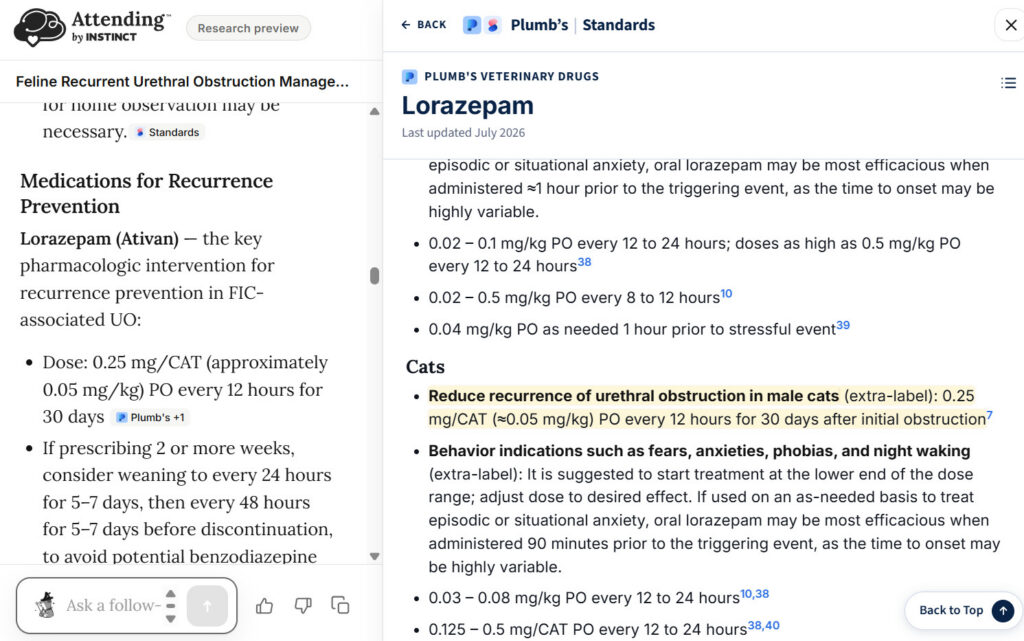
So when Attending mentions lorazepam for your obstructed cat, you can click into the Plumb’s monograph and see a recent update covering its extra-label use for reducing recurrence of urethral obstruction in male cats.
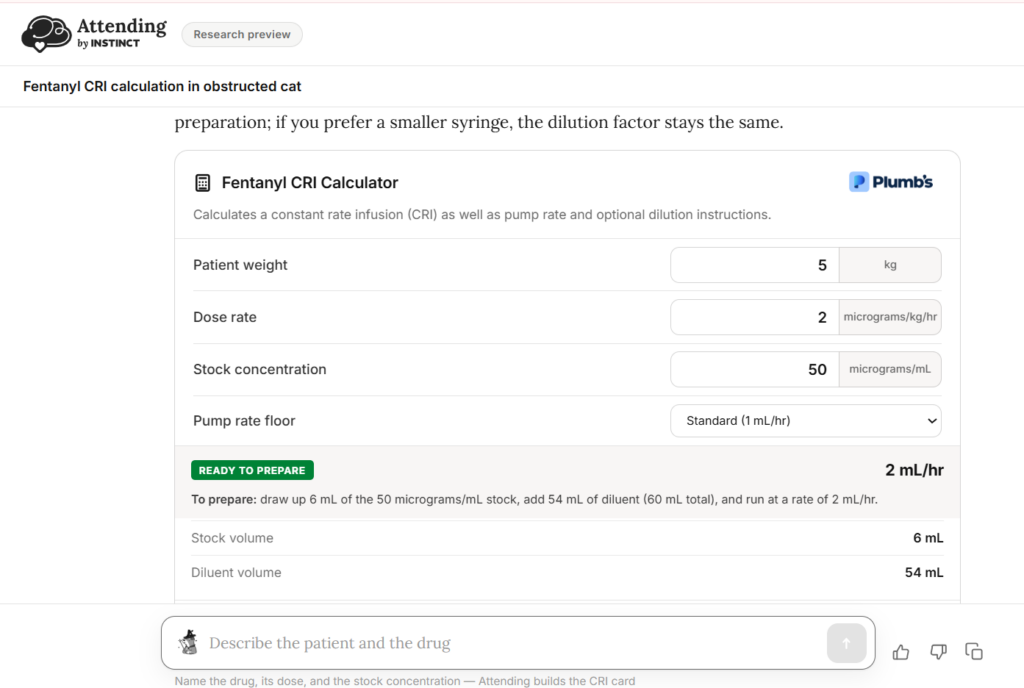
And when a case calls for a calculation, you can do that in Attending too. It includes built-in calculators from Standards and Plumb’s for CRIs, CPR drug doses, free water deficit, lean body weight, NSAID toxicity, and more. Those calculators use fixed formulas, so the same inputs produce the same result every time. Attending also shows the calculation so you can check the math yourself.
Clinician’s Brief: Practical Guidance From Veterinary Experts
Clinician’s Brief has long been one of the most trusted resources in small-animal practice, offering case-based clinical guidance from veterinary experts. Clinical authors are carefully selected, must be board-certified specialists or co-author with one, and must disclose potential conflicts of interest. Clinical content undergoes anonymized peer review as well as internal review by the Clinician’s Brief medical team.
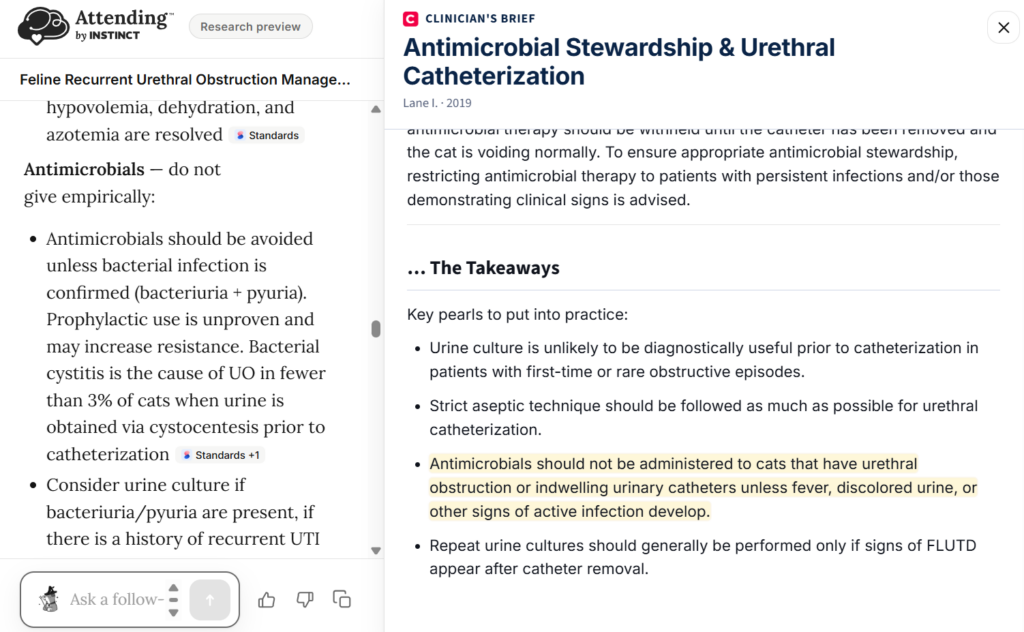
That gives Attending more practical context for how veterinarians work through cases. For your urethral obstruction case, that might mean pulling in Clinician’s Brief guidance on antimicrobial stewardship around catheterization, including when antibiotics should be avoided and when a urine culture is more appropriate.
The Clinician’s Brief team can move quickly when something new comes up, too. When New World screwworm cases were documented in the U.S. in June 2026, Clinician’s Brief had new content on the topic out that same month, with more following in July.
Read: How Multi-Doctor Veterinary Practices Can Support More Consistent Care
Read: Veterinary Patient Safety: Where Risk Shows Up & How Better Systems Help
Making More Time for Clinical Judgment
Veterinarians are right to be skeptical of AI for clinical support. Two of the biggest concerns are that it could miss important context in a complex case or give a recommendation they don’t trust.
At the same time, it isn’t feasible for most veterinarians to spend hours working through the literature for each case. Part of the appeal of AI clinical decision support tools is that they can help you get to answers much faster than you could on your own. But a fast answer isn’t useful if the information behind it is incomplete, outdated, or hard to verify.
You might notice a detail that doesn’t fit the patient or a nagging sense that something got left out and decide to go do the research anyway. Now the tool has cost you time instead of saving it. And the alternative is worse: trusting an answer you shouldn’t have and carrying forward a decision that didn’t serve the patient.
That’s why the quality of Attending’s source material matters so much. Attending draws from veterinary resources developed, reviewed, and kept current by specialists, pharmacists, editors, and practicing veterinarians, and can bring in selected primary literature when more context is needed. The sources stay attached to the answer, so nothing has to be taken on faith. The goal is that when an answer comes back, you can be confident it reflects the best of what the profession has published, not the first plausible thing an AI model could assemble.
Attending can help with the research and recall, but you still bring the part AI can’t: the patient’s history, exam findings, concurrent disease, owner preferences, and the clinical judgment to decide what actually fits.
That’s the balance Attending is built for: faster access to high-quality veterinary information, without asking veterinarians to give up the judgment or scrutiny that good medicine requires.